Saturday, April 27, 2019

Rest & Reorganisation

I'm coming down off one of my worst bouts of illness in recent years. A particularly brutal influenza that manifested with the symptoms of being unable to regulate my body temperature, a cough that can only be described as tubercular, constant headaches, and intense fatigue. It was bad enough to knock me out of work for a full week, and the subsequent one I had to spend it working from home in order to avoid annoying my coworkers with the lingering cough. Unfortunately this meant that apart from one major project cleared, in spite of all this time at home, I was extremely unproductive with my painting.

Now that the illness is on the brink of defeat, with a slight cough being the only remaining rear guard, I have finally found myself with enough energy to do some more hobby. To kick things off I decided to do a full inventory of my outstanding projects on my to do pile, and I've planned out my next sequence of painting logs and organised my storage accordingly, this is the result.

Taking Stock


I'm still only half way through Project Log #5 at this point. However, apart from a full Late War British Flames of War Army, it is down to lots of small projects, single miniature and a lot of Gaslands cars, most of which will probably end up as a birthday gift to a niece rather than undergo the conversion and painting process, at this point I have more than enough to field almost any team I want.

Project Log #6 will be the final push for my lead pile, the sum total of all that remains. While I am going to avoid adding to it as much as possible, it will still take me some time to reach the point where I can officially make a start on it. Unlike my current backlog it is heavy on armies rather than single miniatures, which is going to be a return to the hell of batch painting unfortunately.

Horus Heresy

Way back when I was convinced that I would get into the Horus Heresy gaming I picked up a copy of the the Burning of Prospero to serve as my starting point for a Marine army. I'm still equivocating over which chapter I'll go with, alternating between Dark Angels and Imperial Firsts. Since my interest in it has dropped significantly I'm probably going to save this one until last, as I've had my fill of painting power armoured lads.

Warhammer 40k

In spite of my annoyance with Marines in general I'll probably end up starting and finishing my Chaos expansion first, as my current Chaos army could use a refresh and expansion with the new models from the Shadowspear boxed set and general release. Since 40k is still one of the games that I play fairly regularly I'd also like to get more variety in what I can bring to the table sooner rather than later as well.
I'll also paint the Ultramarine sneaky Marines at some point and add them to my all-Astartes army, but my enthusiasm for them is fairly low, so they'll probably feature middle to last in the priority stack.
I've also got some Gretchin that my parents gave me for Christmas and a 25th Anniversary Marine, which will make a nice display painting project.

Spartan Games

While I sold off most of my old Dystopian Wars stuff I kept the Australian fleet boxed set to paint up at some point, more for display than gaming. I also kept most of the Firestorm Armada stuff and will get to it at some point, mostly the new wave of Terran and Dindrenzi models. I've also got some Planetfall Terrans, which will also be a very simple project to complete. Most of these I intend to use as palette cleansers between major painting projects.

Flames of War

It turns out I still have a lot of Flames of War left over from a bygone era, which I couldn't bear to sell, so still remain in the lead pile. The particular kits I've got are mint early war pre-plastic stuff, so would probably fetch a tidy sum on ebay, but I covet them too much myself. I've got a full Rifle Company and Armoured Squadron for early war, complete with some fearsome Matilda IIs to provide a slow by heavily armoured spearhead to the force. I also have some off brand Vietnam ANZACs that will make a nice APC mounted rifle company with gunship support, mostly for display purposes as well as some small pieces of terrain.

Everything Else

There are a few smaller scale army projects that fit into this pile. I have a second attempt at some UCM from Dropzone Commander, mostly for display purposes as the game is pretty much dead at this point. One of the more interesting projects is some zombie apocalypse survivors and some zombies to menace them. I am planning on using these to test out a home brewed single player war game with AI driven zombies.
I also have some metal WWII German Grenadiers and British Riflemen, about a platoons worth for each. I also have a small bunch of Private Military Contractors and generic insurgents, which I am planning on using for a half formed close quarters firefight game.

The Story So Far

Illness aside, I've been pretty busy since my last blog post. The most significant feature of this period is that I've been on a bit of a Gaslands kick, and have converted a lot of cars.


I've decided to put a moratorium on any further Gaslands war until I get access to a 3D printer for a wider variety of conversion bits. Still, I have more than enough cars to field any kind of team I want. Unfortunately I still have a huge pile of Matchbox and Hotwheels sitting on my shelf that need attention, though at this point I'll probably get rid of most of the leftover cars at this point, as I mentioned earlier.


I also produced a couple of tutorial videos on my usual conversion process for Gaslands cars. My approach is fairly simple and crude, but it is relatively quick for getting cars on the table.

The terrain is also will and truly done, not much more to say about it other than, I'm happy that I won't have to do any more of it until I finally shell out for an urban Realm of Battle board.




Finally, I've made a start on my next project. Getting through my Necromunda gangs, starting with this Goliath test miniature.

That is pretty much it for now, for the rest of the year it'll probably be a continuation of the death march through #5 and #6 looming on the horizon sometime in 2020.

Oh, my regular opponent has thrown his metaphorical hat into the blogosphere, I encourage you all to read him here.


Wednesday, March 20, 2019

Theatre of War

Wargaming is a bulky hobby, and if you area reading this blog the odds are good that you have played at least one game of Warhammer 40k at some point in your career. What is the bare minimum for a decent game of 40k, enough to make the entire table top experience aesthetically pleasing. The two main components being armies of course, fully painted and based to a reasonable standard. I'm generally one of those tiresome bores that will get annoyed about facing bare plastic on the table, this of course is a sliding level of annoyance depending on how much of the rest of the army is painted. But the armies are the main reason for being, everything else is a stage on which these two actors take part in a swirling melee. However, if the stage is neglected, then the final view of the player of the tabletop may not be as immersive as this hobby was intended.

The terrain is one of the most frequently under developed aspects of the experience, often being mismatched, underbuilt, underpainted and generally lackluster in presentation. I personally find that if this aspect is neglected it can take almost as much out of the experience. The worst factor in this, when mismatched terrain. This can result a decidedly odd looking battlefield at the best of times, bleak and uninspiring at worst.  It doesn't make a lot of sense to litter a green fields with densely packed industrial ruins, not unless you go to the trouble of dressing them up in vines and overgrowth to imply the passage of time slowly subsuming the ruins as nature reasserts itself. Likewise trees in the middle of an industrial estate seems out of place, unless you are grouping it like a public park in the middle of a futuristic industrial hellworld. To summarize, theme and consistency make the best tables. It helps enhance the story of the unfolding clash and sets up those game book art vistas, that is of course both of the armies are fully painted.

To get a decent table going time and money need to be sunk into the hobby, and that is on top of any miniatures. The quantities of paints and utilities needed also tend to be far more than most minis, which only exacerbate the financial requirements of a good board of terrain.
The alternative to investment is to have your battles at your FLGS, which may or may not be your local games workshop. I am fortunate enough to have an excellent FLGS nearby with an extensive range of terrain and plenty of table space. However, this is not always an option, so and you may find yourself a slave to opening hours and the whims of your fellow gamers if this is your venue of choice. However, still cheaper than building a board. However I'd like the flexibility to do both as needed, home after all, is where all my things are and I like it there.

So, this was a long lead in to what I've been painting, which is a lot of Games Workshop terrain. It has been burning a hole on my to-do shelf and I've finally made the jump to burl through it at as fast a pace as I can managed. To be honest I find I've been dropping my standards and attention to detail in order to get it across my desk. At the time of writing I've knocked off a lot of the smaller stuff, and I'm now facing down the larger sets of ruins. To help me get through it I've found myself pulling a smattering of different projects off the shelf and prepping them for a paint job. I do worry that this is I'm going to find myself in a situation where I have a dozen different projects in a halfway state, a state that I would prefer never to get into again.

Terrain


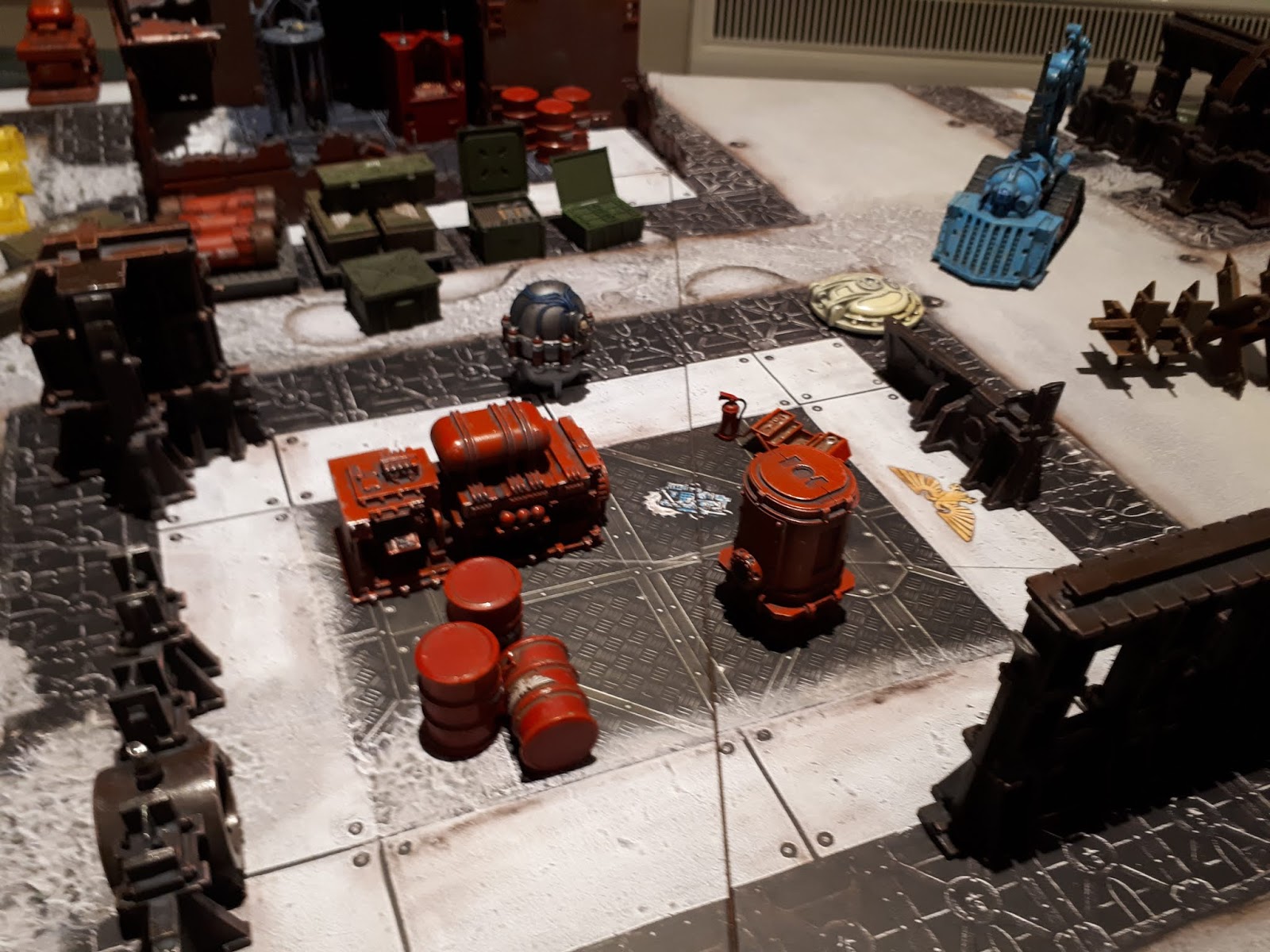
I don't normally do a massive assembly run like I did with this batch of projects, but terrain does make itself uniquely suited for doing it due to the need to paint the terrain in a slightly unified fashion. Also the fierce Australian summer is in retreat and more and more days are falling into the temperature range that allow for comfortable airbrush sessions on my balcony. So I'd like to have all of it ready to go for when a I get a particularly good day to paint.


Most of the work is fairly simple and requires no real finesse to accomplish. For these trees I layered up the trunks, painted the mushroom clusters khaki, washed the lot of it with Agrax, then drybrushed the at layer with VMC Buff. The alien flora I painted with whatever I had lying around in my crate of VMC, washed it and drybrushed it with whatever colour I felt appropriate. Overall the effect is good enough for table top.


Actual machinery and buildings are a far greater challenge than plants as you have to be a bit more precise with the painting. However, for the sake of expediency I chose to pick a primary colour, a secondary to accent it, and a few parts for metallics. This keeps the time needed for basecoating down, as the largest coat can go down with an airbrush and the secondaries aren't much in terms of surface area. Once that was all done, with a few drybursh highlighting passes to taste, I used a sponge technique to beat up the metal components to add a chipped, scratched and well worn technique. While I did not do the best job with this technique it was good enough to add some interest to the model. Finally, a gloss coat of floor polish down, then I went to town on them with my AK enamels, adding and taking away to taste with a variety of colours until I was happy with the result.

Minis


The last of the Kill Teams went by pretty quickly, overall I think I hit a high tabletop standard with all of them, and it was nice to try my brushwork on a wide variety of the GW catalog, rather than batching painting wave after wave of either Space Marines or Guardsmen.


For the Genestealer Cult I got a chance to use wash painting for a project larger than a single miniature. Overall I'm extremely happy with the finish and the ease that it went down. I'm thinking about using this technique for some Heresy era Imperial Fists at some point.


I did try to produce some tutorials while doing my Ad-Mech and stream my painting as well. I ended up dumping the footage on youtube without much post production work. I didn't much feel like editing it, and the camera work wasn't that great to begin with. So bare minimum effort, but in future I'll try to edit these down more, two hours of paint streaming is not that interesting.


For my Deathwatch I took this opportunity to do another tutorial on painting flesh. This time I experimented with the camera and did a commentary pass after the filming was complete. While the quality was significantly better, and edited down to be watchable, it was still not quite up to a good standard. Howqever this is all the effort I'm willing to put in right now as this is not my job, nor do I care about monetization.


Finally, Monty here is my first part of my next Moments in History piece. Surprisingly quick and easy to do to be honest, as it is a technique that relies a lot on manual shades applied with a brush rather than an overall wash, so drying time tends not to be an issue. Unfortunately I'm not thrilled with working on Rommel right now, so we'll see how long he remains on my painting desk. That is pretty much everything for now, I'll see you in a month or two.


Wednesday, January 16, 2019

To Vanquish The Plastic

Everyone gamer has a shame pile, a backlog, a collection of kits in various stages of completion that one will probably never get to. For me however, there appears to be an end in sight.
I think I'm ready to start wrapping up the hobby, at least in terms of the volume I have been producing. I'll still probably always paint, but I'm at a stage in my life where the armies I have currently painted, and the ones that are currently waiting for their turn on the backlog, are all I'll need. Any future expansion will either be small addons to a single a project or a small project that will consist of a handful of miniatures or even as few as one or two.

One of the reasons for this is that I've been in a bit of a funk about my hobby for some time now. Over the years I have finally developed my skills to a point of a mid to high painter, not award winning, but competent. However I don't quite feel the pride that I used to at the sight of my completed armies, nor the enthusiasm to build more. However, in the end I have a hard time feeling that I have much to show for it, a lot of miniatures for many systems, most of which I'll never play and in the end when I do play it is infrequent due to other life commitments and general fatigue. When I look at the fresh, unopened boxes on my shelf, I'm not feeling excited or challenged by new projects, I'm beginning to feel like all of it is simply more work, which is a horrible thing for your hobby to turn into.

The reasons for this change are many most of which I feel are related to a long term depressive downturn, which I know has been happening to me for a while. I've certainly been feeling a similar lethargy with my other hobbies and distractions in my life. So that is certainly part of it, if not the main cause. I suspect that my tastes may also be changing, especially as larger and larger sections of Gamer/Nerd culture start showing their arse in terms of precisely how reactionary they really are. For example I used to look forward to a revival of Star Wars as a franchise, now everything is Star Wars and I can't think of anything worse that the culture around the fandom. Please don't interpret this as a plea to banish politics from our favorite franchises because as we all know everything is deeply political, most people haven't realized it until now. 40k doesn't quite have this problem with the fandom advertised and reported on to the extent that it has been done for other fandoms, but even the small scratch in the surface reveals a community of gamers that completely missed the hidden curriculum, and now gleefully photoshop the heads of prominent world leaders onto the body of the Emperor of Mankind without a trace irony. It is not pleasant to be part of that.

I think what I need is to stop the hobby from feeling like an arduous task, which ultimately boils down to several critical factors.
  1. No More Armies
    The downside the army painting is the by definition repetitive nature of the painting. You can't create something distinct and uniform on the table top without committing to one universal colour scheme. This means one colour scheme, one method for efficiency, which spells death for any chance of creativity.
  2. No More Batch Painting
    Productionising painting, while great for getting things done, has turned out to be bad for experimentation. My new goal going forward is to paint individual minis from start to finish and use this as a chance to exercise a lot more creativity.
  3. More Variety
    Single minis means the opportunity to branch out and try new things. I know plenty of techniques that I have yet to even try due to the lack of a proper miniature to paint. So, no more squad boxes, just three to four minis at most, a blister pack size if you will. Any more than that and I'll slip back into a painting funk again.
  4. Avoid Discourse
    There is a massive online culture war now in pop culture at large, which mostly comes from politics and bleeds over into every facet of life. That is not to say that these conversation are inconsequential, important questions about representation in pop culture, and appropriation are starting to get asked which is a good thing. However, the ongoing background radiation of the discourse takes a toll on me mentally. I also suspect it is why I have a hard time uncritically enjoying things anymore. If Discourse Poisoning isn't a term, it should, because that is what I feel like I have. The solution is not to shut it out completely, but to limit my intake, if only to avoid outright self loathing, while maintaining just enough to know what is going on.
Hopefully this will stop the hobby, and my unpainted pile of plastic from feeling less like a millstone around my neck.

What I've Been Painting

In retrospect, and in spite of my own deteriorating mental health, my progress has been quite good.

The first major project fully completed has been a significant extension to my Team Yankee Soviets. My intention was to bring them up to a tourney legal amount in terms of points, but it turns out I'm not going to be playing them this year. Maybe some other time.
In terms of technique, the vehicles are some of the quickest I've painted. A simple basecoat, wash, re-layer, transfers, then drybrush method worked a treat. The infantry on the other hand were a slog, and has given me some appreciation for the amount of work I'll be up for when I finally commit to rebuilding my late war British for Flames of War. I've wrote up the a detailed guide for how I painted the infantry on this very blog, if you haven't already seen it.


Another project I did immediately after I wrapped up the Team Yankee was to do a video specifically about my method for painting up fifteen mil minis. In terms of tutorial quality I think this is one of my better attempts, and the fact that I didn't record audio after the fact certainly helped with explaining what I am doing. I've also been convinced to try streaming again by some arty friends. I'll try to occasionally do it on a Sunday, and mostly focus on single minis and small projects to keep it interesting.


I also got around to finishing Steelheart's Champions. While I don't think they are at competition level, I am happy with the result and if I paint any more Stormcast I'll probably stick to this scheme and make them my own custom Stormhost. I'm thinking the Knights Ethereal.

I've made a dramatic start to my Kill Team projects. So far I've finished some Space Wolves using the standard GW method and some Orks where I tried to get a bit experimental. While they both turned out fairly well, I think some of the metallic chipping didn't quite work on the Orks, and I've got a variation to try with my next kill team, I'm thinking the Ad-Mech as a candidate.


In hobby related news I'm starting to run out of storage space for my minis, which is a good thing as it means I can start to focus more and more on smaller, less space intensive goals. To cope with this I have been looking for interesting storage and display solutions. It turns out that clear perspex risers and drawers from office works generally works pretty great. I'm planning to buy a few more of these to store my Late War Brits.


I've also consigned a bunch of my old minis to the stripping vats. My old Battlefleet Gothic fleet is in their along with a selection of 40k single minis and Flames of War tanks. I'm hoping to treat them as one of projects for video tutorials and livestreams.


That is pretty much it, life goes on as does the little things we do to distract ourselves from it. I'll let you know how I'm going in the next whiny sad-post.


Monday, December 17, 2018

Company of Comrades

To most painters 15mm figures can be quite intimidating. The details are generally small, and tend to rely on the composition of figures as well as the strength of the basing work to tie the entire miniature together. Recently I decided to expand my Team Yankee army in the anticipation of entering in the Team Yankee two day tourney at Cancon. However, I didn't get my entry in so it seems to be all for naught. Never the less, I now have a full Battalion of Soviet Motorized Rifles. Since I haven't seen much material in terms of how to paint 15mm, so I think it'll be useful to share my standard method for painting infantry at 15mm.

1. Preparation and Mounting

First stage involves unpacking the miniatures from their box and cleaning up any mold lines. I usually do this with a scalpel and a very light file. Once the miniatures are cleaned up I mount them, about six at a time, to a paddle pop stick. In turn, I mount the paddle pop stick on one of my usual miniature painting model stands, in all cases using blu-tac for adhesive.

 2. Priming

I tend to prime in big batches, in this case I primed all miniatures in the batch at once using my usual method. First a Chaos black layer, worked into all angels and recesses. Once that layer is dry I give the miniature a 45 degree zenithal highlight with Corax White. This layer catches all of the highest highlights and helps emphasis the highlights after applying our first layers.

3. Main Basecoat

In most cases the first basecoat I put down is the main uniform colour. In this case VMC Green Brown. I did the initial application with an airbrush, however due to feed problems I ended up doing the last layer with a brush.

4. Basecoat of Details

This is by far the most tedious stage of the painting process. This involves using a fine tipped brush to paint all of the major colours on the model. While all of the colour choices were lifted from the Team Yankee rule book, I translated them as best I could into Vallejo Model Colour.
  • Helmet & Painted Metal - US Dark Green
  • European Skin - Flat Flesh
  • Webbing - Khaki
  • Boots - Black Grey
  • Metal Parts - 50/50 mix of Black and Gunmetal Grey
  • Rifle Furniture & Magazine - German Camouflage Orange Ochre

5. Washing

This stage involves a single application of Agrax Earthshade over all colours apart from the flesh, which will get an even layer of Reikland Fleshshade.

6. Re-Layering

This stage involves re-layering all of the mid-tone colours to reestablish the mid-tone while ensuring the deeper recesses remain the shaded colour. This is probably the second most tedious stage of the painting process. About seventy percent of the model's surface should be painted this colour.

7. Highlights

For my highlight colours I typically use the mid-tone colour with some VMC Buff mixed in. The exceptions are VMC Highlight Flesh for the flesh highlight, and pure VMC Gunmetal Grey, applied very sparingly to the metal components.

8. Base Work

I usually use my standard basing method to base fifteen mil miniatures as well. The chief difference is that I glue some tufts of railway flock on the base along with the static grass to represent bushes.


That is pretty much it for my standard method for painting 15mm. This works for almost all colour scheme and is fairly easy to adapt to a wide variety of subject matter. I hope this helps with your own projects.